
Blog
The Morning the Books Disappeared
On Friday, December 27, 2024, thousands of American small business owners tried to log in to their accounting service and couldn’t.
Bench was one of the largest bookkeeping companies in the country. It kept the books for thousands of small businesses, and it had just ceased operations with no warning. Not to its customers. Not even to its own 650 employees, who found out the same way everybody else did.
The timing was almost unbelievable. Four days before year end. Right as every one of those businesses needed their numbers for taxes.
The story has an ending, sort of. Employer.com announced an acquisition the following Monday, and Bench came back in January. But for a stretch of days, a lot of owners sat with a question they had never thought to ask.
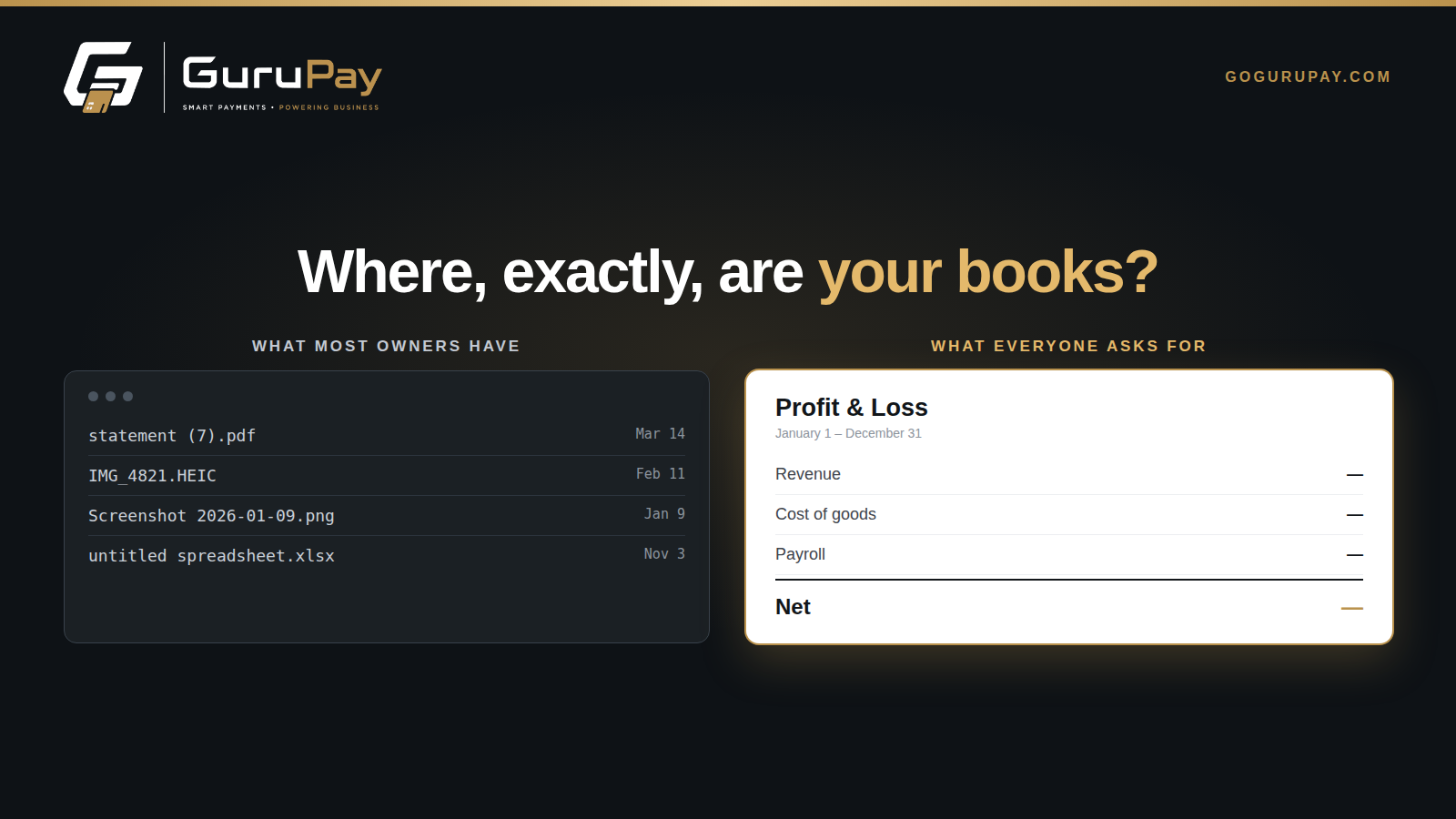
Where, exactly, are my books?
Here’s the part worth sitting with. The owners who moved through that week without much trouble were not the ones with the best software. They were the ones who already knew their own numbers. They could tell you what they did in November, roughly what they spent it on, and where the money went, because they had been looking at it all year.
The ones who struggled had been treating bookkeeping as something that happened somewhere else. A service they paid for. A file their accountant kept. Something handled.
That’s the real distinction. Not between people with good books and people with bad ones. Between people who can answer questions about their own business and people who have to go find somebody who can.
What books are actually for
Ask a small business owner why they keep books and almost all of them will say taxes.
Which is true, and which is also why so many of them do it badly. Taxes are a deadline you meet once a year for somebody else’s benefit. Nobody does their best work on a chore.
But that’s not the real reason, and once you see the real reason it’s hard to unsee.
The real reason is so you can say yes.
A space opens up two doors down at a rent you’d never see again. A grant program posts with a deadline in three weeks. Your equipment finally dies and somebody offers you financing on a new one. A competitor decides to sell.
Every one of those is an opportunity with a clock on it, and every one of them ends with somebody asking you for a profit and loss statement.
The owner with clean books exports one page and gets on with their day.
The owner without them opens their Downloads folder. There are nine files called statement, statement (1), statement (2). Some receipts live in their camera roll as screenshots. Others are in Gmail somewhere, findable if you remember the vendor’s name. There’s a spreadsheet a former employee started and stopped updating in March. Venmo and Cash App have their own histories that don’t export cleanly into anything. And the bank portal only shows statements going back so far, which becomes a problem around the time you realize the lender asked for two years.
By the time all of that is assembled, the window has usually closed.
The books aren’t for the accountant. They’re the thing standing between you and the answer yes.
On picking the software
This part matters less than people think, which is inconvenient, because picking is the part that feels like progress.
There are a handful of good options and they mostly do the same core job. QuickBooks is the one most accountants already work in, so if yours has an opinion, it’s probably that. Xero doesn’t charge you per person, which matters if you and your spouse and your bookkeeper all need to be in there. Zoho Books gives you a lot for very little and stays free while you’re small. FreshBooks is built around invoicing, so if you bill for your time rather than ring up sales it will feel right immediately. Wave is free to start, which makes it the easiest way to stop doing nothing. Ambrook is built for farms and ranches, with categories that match how that work actually gets taxed and funded.
Any of them beats a folder of PDFs nobody has opened. Pick the one shaped like your business and stop researching, because every week spent comparing is a week of transactions you’re not recording.
The part that costs real money
Almost nobody starts this because they want better books. They start because a deadline showed up.
And here’s where it turns against you, quietly. It scales with your success. A business doing $40,000 a month has roughly four times the transactions of one doing $10,000. Four times the sorting. Four times the questions your accountant asks about a Tuesday last June. Four times the rush fee.
The busier you get, the more expensive it becomes to have put it off. Which is exactly backwards from how it feels, because the busier you get, the less time you have to deal with it.
The people who never go through this aren’t disciplined in some way you aren’t. They did a small thing every week, all year, and when the moment came they downloaded a file.
Making it happen on its own
Everything above assumes your sales actually reach your books. That’s where most people stall.
Three ways it happens. Some registers and accounting programs talk to each other on their own, for free. Some need a small connector in the middle, usually twenty or thirty dollars a month, set up once and then forgotten. And some don’t connect at all yet, in which case you pull the weekly sales summary and enter it as a single line.
That last one takes about fifteen minutes on a Monday, and it is not the consolation prize. An owner entering one line a week by hand has better books than an owner who bought the software and never hooked it up.
However it happens, the goal is the same. Your numbers live somewhere you control, they’re current without you having to remember, and the page is ready before anybody asks for it.
So that when the thing with the clock on it shows up, and it will, the answer can be yes.
Questions about this article or the Guru Brief?
Email marketing@gogurupay.com or call (844) 725-3933.
Guru Pay helps with onboarding, checkups and billing questions, including when you cannot reach your provider, from 8 a.m. to 8 p.m. Eastern. Direct 24/7 technical support is available through your POS provider.

Guru Pay is an Atlanta merchant services team. We help business owners set up, protect and grow the way they get paid, and we write here about what we see working with shops, restaurants and high-risk merchants every week.
Talk it through with our team →