Blog
Texas Went First
On the last Thursday in July, a shop owner outside Austin stayed after close and took his own wall apart.
He had built that wall over four years. Gummies at eye level. Cartridges in the locked case underneath. Flower in jars along the top where the light caught them. He knew which shelf moved on a Friday night and which one moved on the first of the month. By midnight most of it was in contractor bags by the back door.
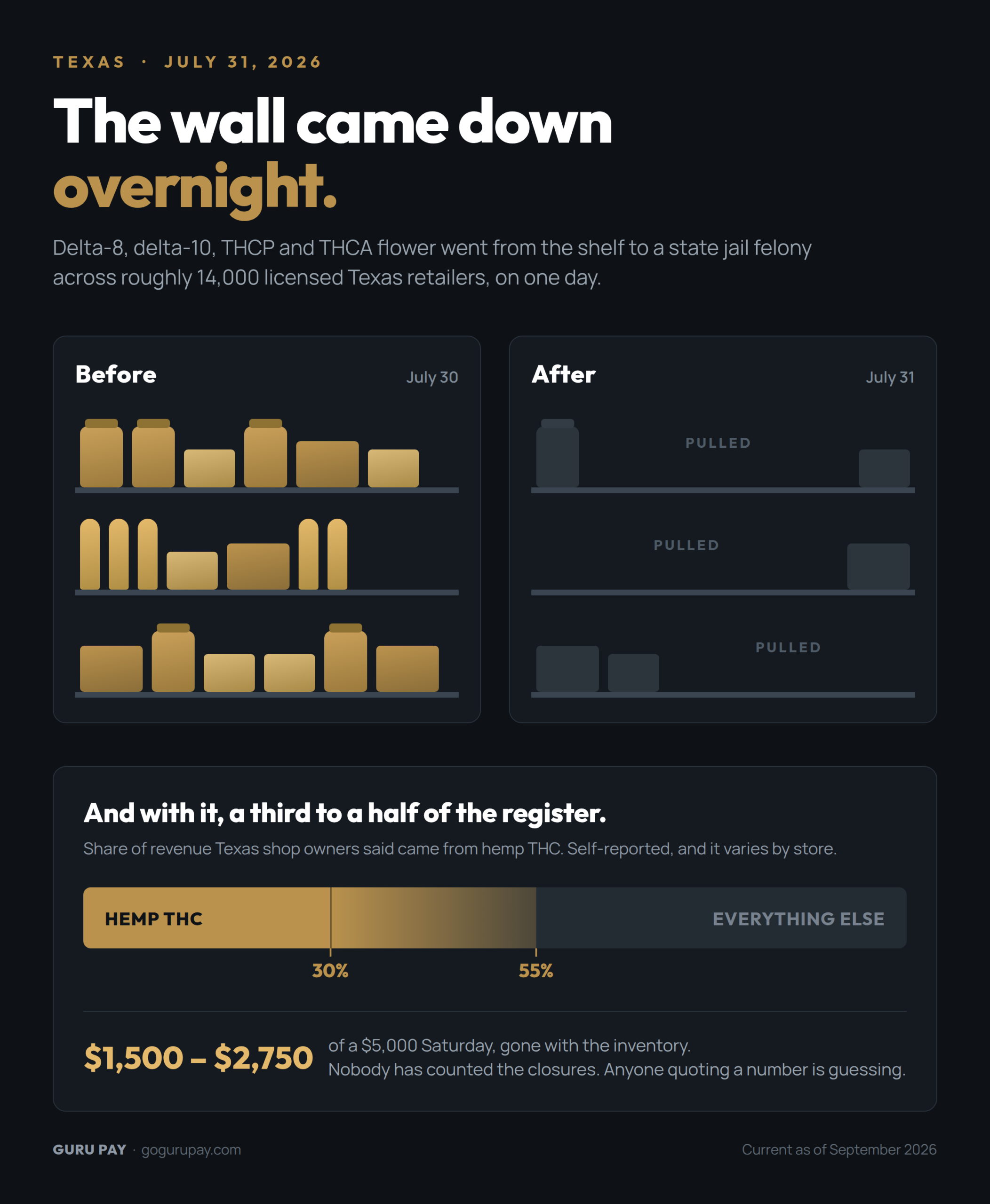
That was July 30, 2026. The next morning, most of what had been on that wall was a state jail felony to possess in Texas. Delta-8, delta-10, THCP, THCA flower. Gone, statewide, at once, across roughly 14,000 licensed retail locations.
Here is the part that matters, and it is easy to miss on a night like that. The ban did not close his store. Plenty of Texas shops made it through the summer. What separated the ones that were fine from the ones that were not had very little to do with the law. It had to do with a decision each of them made two or three years earlier, without knowing they were making one.
The wall was never the business
Ask a shop owner what hemp THC was worth to him and he will tell you a percentage of sales. A handful of Texas owners have said it out loud. One Austin shop put smokable hemp at 43% of sales. Another at 50%. A third said more than half. Across the independents who have put a number on the record, it lands somewhere between 30% and 55% of revenue.
Nobody has counted the closures. Anyone who tells you how many Texas shops went under is guessing.
But take the middle of that range and put it in a real store on a real Saturday. A shop that rings $5,000 on its best day of the week just watched about $2,000 of it leave in a contractor bag.
And the $2,000 is the smaller loss.
Think about where the milk sits in a grocery store. All the way at the back, past everything else. That is not an accident. The milk is not where the money is. The milk is the reason you walked in, and the store makes its money on everything you pick up on the way to it.
The wall was the milk. The customer came in Thursday for the gummies and left with a lighter, a drink, a pack of papers and a glass piece he had been looking at for a month. When the wall came down, the store did not lose 40% of its revenue. It lost 40% of its revenue and an unknown share of the trips that produced the other 60%.
That is the number no owner had on a spreadsheet, and it is the one that decides who is still open in a year.
Then there is the second hit, and almost nobody sees it coming
Your merchant account is not a utility. It is a description of a store, written on the day you were approved, and filed with a bank that is on the hook for what you actually sell.
When the store changes overnight, the description does not change with it. That opens two doors, and both of them lead to the same place.
The first door is the shop that quietly keeps selling the old inventory. Under the counter, or out the back, or on a website that does not look like the website the underwriter reviewed. In payments it is called transaction laundering, and it is the most common single reason a shop in this category loses processing. The bank is not just allowed to go looking for it. It is required to.
The second door is crueler, because the owner is doing the right thing. He pivots hard. New beverage line, online store, delivery, a brand-new mix on the shelf. Volume comes back. And then one morning the account is on hold, because the bank was told to expect $18,000 a month, mostly card-present, from a smoke shop. What it just saw was $60,000, half of it card-not-present, from a store that no longer matches its own file.
Nobody committed fraud. Nobody told the bank anything. That was the whole problem.
A pivot done quietly and a scheme look identical from the underwriting desk. The only difference is a phone call, and the owners who made that call kept processing.
Why this matters if you have never set foot in Texas
There is a version of this story where Texas is a Texas problem. That version is wrong, and the reason is on the calendar.
Congress rewrote the federal definition of hemp. The new line counts total THC including THCA instead of delta-9 alone, caps finished products at 0.4 milligrams per container, and excludes cannabinoids made in a lab rather than grown in the plant. The bulk of it lands December 11, 2026. A narrower slice of true synthetics hits about a month before that. We walked through the mechanics of that rule in a separate piece here.
One honest caveat. That December date is attached to a temporary spending bill and it has already been pushed back once. It can move again.
Meanwhile the Texas rule that started all of this is still being fought in the Fifteenth Court of Appeals. The state filed its reply brief in September. The rules stay in effect while the appeal runs, which means a Texas owner is operating under a standard that could be struck down, upheld, or made permanent, and he has to stock his store either way.
So Texas did not get a special punishment. Texas went first. Every vape and smoke shop in the country is watching a dress rehearsal for a national performance with a date on it, and the rehearsal already told us which owners come out the other side.
What they did, and none of it is exotic
Three things. They are not clever. They are just early.
They replaced the trip, not the margin. The instinct after a ban is to find a product with a similar markup. That fills the shelf and does nothing for the door. The shops that held their footing asked a different question: what brings this same person in on a Thursday now? Sometimes the answer was a new category. More often it was a reason to come in that had nothing to do with a product, and a second channel that brought the store to people who had stopped walking past it.
They told the processor before the shelf changed, not after. Ten minutes on the phone, in advance, describing the new mix and the new volume. That is the entire difference between a pivot and a hold. It is the least glamorous item on this list and it is the one that saves accounts.
They knew what each item actually cost them. Most independent shops price off the invoice and a feel for the market, which works fine when one category is carrying the store. The moment that category disappears, feel is not good enough. The owners who could open a screen and see true cost per item, landed, with freight and shrink in it, filled their empty shelf with things that made money. The ones who could not filled it with things that moved.
The options in front of you
There is no single replacement for what came off that wall, and anyone selling you one is selling you something. What exists is a handful of directions, and most shops end up using two or three at once.
Compliant hemp lines built to the new ceiling. Product designed from the start against total-THC math and the per-container cap rather than the old 0.3% line. The benefit is that you stay in a category your customers already come to you for, with suppliers who can document what is in the package.
Non-intoxicating and functional categories. Beverages, botanicals, wellness lines. Lower regulatory heat, a broader customer, and in most cases a far easier conversation with a bank.
Off-premise revenue. Delivery marketplaces and your own online ordering. Uber Eats, DoorDash and Grubhub all reach customers who are not driving to a strip center on a Thursday, and setting a store up on them is a known, finishable project. This is the fastest way to replace trips rather than just margin.
A point of sale that actually reports. If you cannot see cost per item and category margin without exporting to a spreadsheet, you are making inventory decisions blind at exactly the moment they matter most. Modern systems handle this out of the box.
A processor who works this category on purpose. High-risk specialists underwrite the whole store, expect the mix to change, and will talk to you before it does instead of after. The benefit is not a number on a statement. It is that the phone gets answered by someone who already knows what a total-THC rule is.
Where we come in
We place payment processing for vape, smoke and hemp retailers, and we do the first-90-days work most owners never get to. Getting delivery live. Getting inventory and true cost per item set up so you know which shelf is actually paying you. Making sure your processing file matches the store you are about to become instead of the one you used to be.
Tell us what is on your shelves today and what you are planning to put there. We will tell you where your exposure is before December, what needs to be disclosed, and what approval looks like. If your setup is already fine, you will hear that from us.
Current as of September 2026. The Texas rules are under appeal and the federal hemp deadline is tied to a temporary spending bill that has already moved once. Verify current dates before acting.

Guru Pay is an Atlanta merchant services team. We help business owners set up, protect and grow the way they get paid, and we write here about what we see working with shops, restaurants and high-risk merchants every week.
Talk it through with our team →